
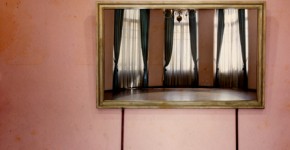
Ontem by André Cepeda in Berlin

16 01 2012

André Cepeda captures chaotic, claustrophobic interiors, marks of self-destruction, moments of reinterpretation of still lives and thereby shatters the conventionality of private spaces as we know them. He photographs the so-called islands of Porto, characteristic architectures of the late 19th century and the early 20th century: behind a nondescript street entrance, we find a long line of houses offering minimum conditions of habitability, thus creating a small self-enclosed urban nodule, similar to the famous English back-to-back houses.


Ontem
by André Cepeda

14th January – 25th February 2012

Galerie Invaliden 1, Berlin


PR Text: It is curious when artists embark upon individual works that require many years to be completed. In the world of contemporary photography several examples of spectacular commissions that result in monographic works that offer a more or less tensive response to the original brief can be found. I remember discussing this project with André Cepeda about four years ago. A handful of his pictures were linked to spaces in the city of Porto, where we both lived, and despite being exterior settings, they achieved to provide a sense of intimacy: interior patios, plants in small open-air recesses, elements of exasperating banality to which the artist conferred it’s intrinsic dignity.

I soon realised that he intended to systemise his wanderings through the city, as it was perceived by the artist himself but without revealing the area’s inner reality. He began a process of physical demarcation of the territory, meeting inhabitants who normally remain hidden from passers-by. One of the typical phenomena of Porto’s urban development of the late 19th century and the early 20th century is the so-called islands: behind a nondescript street entrance, we find a long line of houses offering minimum conditions of habitability, thus creating a small self-enclosed urban nodule (very different from workers’ houses in comparable neighbourhoods in Lisbon, that were structured around central courtyards). This urban design mimics patterns found at the dawn of the Industrial Revolution in the United Kingdom (the famous back to back houses), but normally embodies a smaller and more wretched vision. These developments were carried out in response to Porto’s growing industrialisation, but now they are obsolete, left as relics of industrial archaeology. The working class has effectively disappeared and these areas nowadays belong to a significant subset of the elderly, unemployed or economically under-privileged.

Nevertheless, it should be emphasised that there is often a strong sense of community in such neighbourhoods and some of these areas now have considerably more pleasant conditions than those existing at the time of their construction, where basic sanitation and plumbing were achieved at best via improvised shared solutions. André Cepeda began his work on the basis of this specific territorial and urban demarcation. As I explained above, I was impressed by the way in which the project was developed: its conceptual rigour and discipline obliged the artist to spend days on end looking for places that held significance for him, looking for details that he expertly captures and which immediately endow a sense of pungent universality to the picture in question.

… (read on LINK)

Info + illus. courtesy Invaliden 1


New “Porto Interiors” by Inês d’Orey shown in Porto

6 03 2011

An exhibition at Porto presents new works of Portugese photographer Inês d’Orey‘s striking, ongoing series “Porto Interior”. To find out more about Inês’ work and her intentions, please read this interview she gave deconarch.com some time ago.

© Inês d'Orey

© Inês d'Orey

.

.

Porto Interior

From 12th March until 15th May 2011.

Edifício da Ex-Cadeia e Tribunal da Relação do Porto

Porto, Portugal

www.cpf.pt

.

.

.

.

PR info: Inês d’Orey returns with new incursions through Porto, scattered in time and space. After de New Talent Fnac Photography 2007, the (re)discovery of the city has been continued. Unlike immediate appearances, the city seems to be growing, intimately.

When punctuated by the absence of any human being, the public and semi-public interiors spaces of the city are hit by an alteration in the meaning and in the identity imprinted on Porto. What the city represents becomes thereby more extreme. These spaces, apparently stagnant, transform themselves into a series of generic places, existing and subsisting in a lost time.

Therefore, these images are offered as stages, always with a different story to tell. The intention is not to document as an objective process, but rather to explore the possibility and the impossibility of a porto interior, where one arrives and remains.


Inês d’Orey: Porto Interior

17 07 2008

(UPDATE)

Inês d’Orey (*1977 Porto) ist eine junge portugiesische Fotografin, die 2007 für ihre Serie „Porto Interior“ mit dem Fnac Prize New Photography Talent ausgezeichnet wurde.

Ein paar Aufnahmen dieser Reihe habe ich beim 2. Fotofestival Mannheim_Ludwigshafen_Heidelberg 2007 „Reality Crossings“ gesehen. Die Fotografin ist zwar nicht auf Architekturaufnahmen ausschließlich spezialisiert, aber „Porto Interior“ ist auf jeden Fall eine Erwähnung wert.

“I’m looking for the uncomfortable and asphyxiating banal, the sad and melancholic proximity. […] My aim is not to document these spaces, but to explore the possible and the impossible in an interior harbor.”

Ines d’Orey. Campanha Campanhâ (Schwimmbad/swimming pool)

Porto Interior zeigt Aufnahmen von (meist) öffentlichen, aber menschenleeren Innenräumen in d’Oreys Heimatstadt Porto. Die Künstlerin hat diese Bilder selbst aufgenommen und anschließend digital bearbeitet.

Entstanden sind entrückt wirkende Szenerien in Farben, die wie von einer andere Welt wirken. Die eigentlich vertrauten Orte erscheinen durch die Bearbeitung fremder, ungewohnter, spannender, anziehender. Alltägliche Räume, denen man sonst nicht viel Aufmerksamkeit schenkt, werden plötzlich ganz anders wahrgenommen.

Mehr Bilder nicht nur zu Porto Interior auf der Website der Fotografin.

PS: Ich habe mich in dieser Beschreibung auch am Katalog des Fotofestivals orientiert; dort wird der missverständliche Aussage gegeben “Ihre Motive findet sie in historischem Bildmaterial, das sie … digital überarbeitet”. Tatsächlich hat die Fotografin die Bilder aber selbst aufgenommen und nicht, wie ich zuvor geschrieben hatte, mit alten historischen Fotografien gearbeitet. Ich habe meinen Artikel daher entsprechend korrigiert.

Inês d’Orey (*1977 Porto) is a young Portugese photographer who won the Fnac Prize New Photography Talent 2007 for her series “Porto Interior”.

I could see some pictures of this series at the 2. Fotofestival Mannheim_Ludwigshafen_Heidelberg 2007 „Reality Crossings“. Even though the photographer is not specialized in architecture photography only, „Porto Interior“ is still worth mentioning.

“I’m looking for the uncomfortable and asphyxiating banal, the sad and melancholic proximity. […] My aim is not to document these spaces, but to explore the possible and the impossible in an interior harbor.”

Porto Interior shows photographs of (mostly) public, but deserted interior spaces of d’Orey’s home town Porto. The artist took the pictures herself, and digitally modified them afterwards.

Thus, she created sceneries seemingly disconnected from reality, with colours that appear to be from another world. After the modification, the usually familiar spaces appear strange, unknown, more exciting, attracting. Topical spaces, generally not really noticed, are suddenly perceived in a totally different way.

More info not only about “Porto Interior” on the artist’s website.

PS: When writing this article I also used the fotofestival’s catalogue for information; yet there is provided the somewhat misleading sentence “D’Orey finds her motifs in historical images which she digitally reworks…”. Actually the photographer has taken the pictures herself and did not, as I have written before, used old historic photographs. Thus I have corrected the article accordingly.